The production Dashboard brings your current banking-system position, recorded history, net worth, capital activity, repayment progress, and data freshness into one view. It reads the records entered elsewhere in Policy Stack and does not change them.
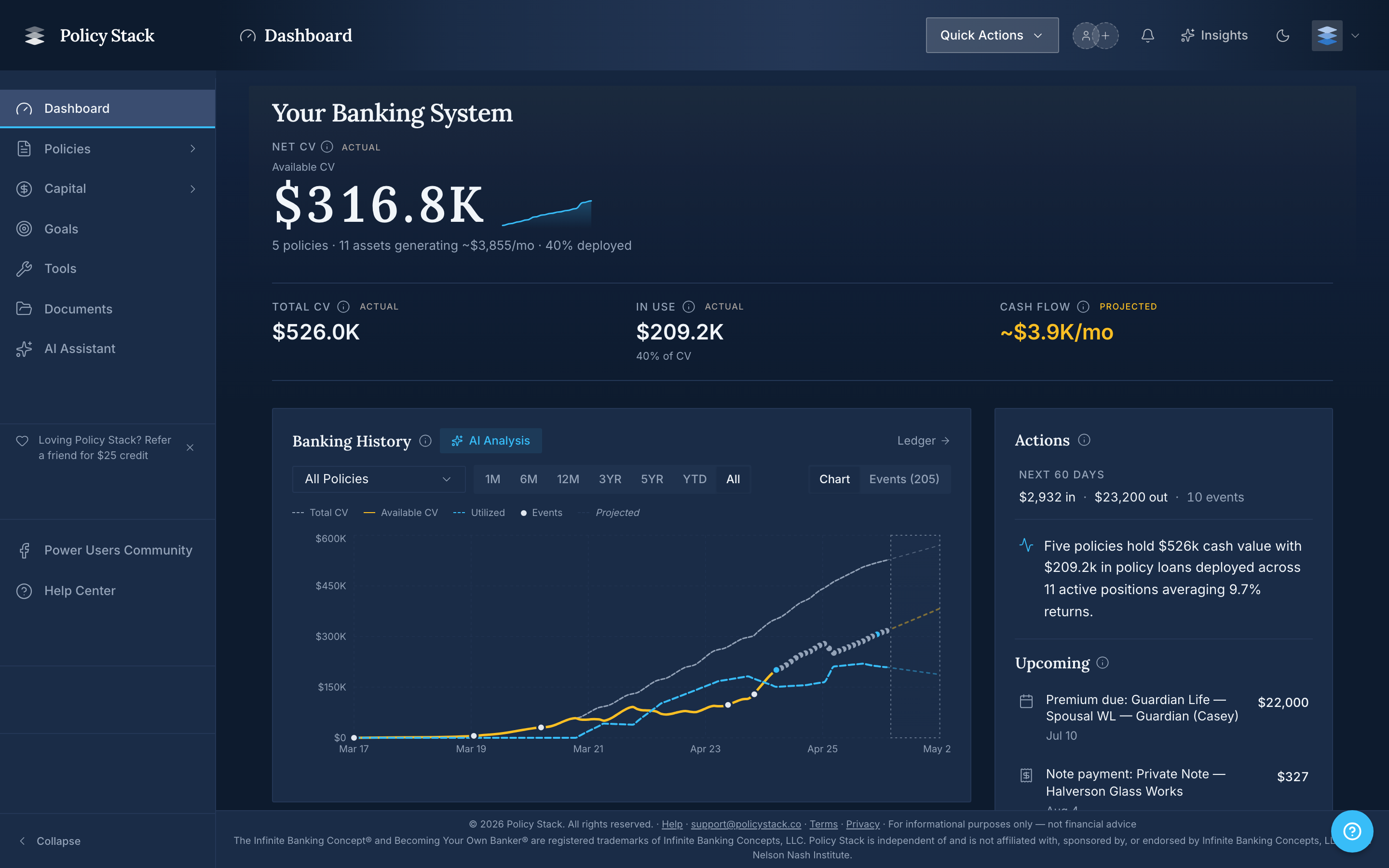
Read the System Position
The hero leads with Net CV, also labeled Available CV: Total CV minus recorded policy-loan balances. It shows Actual recorded data and a 30-day change when enough snapshot history exists.
The supporting strip separates:
- Total CV — Actual carrier-reported cash value from the latest snapshots
- In Use — Actual recorded policy-loan balances
- Cash Flow — Projected monthly cash flow from recorded asset schedules
Actual is the visual default when a surface clearly presents recorded values. Planned, Projected, Modeled, Computed, and other non-Actual values keep inline source badges. Mixed-source comparisons and legends may also label Actual explicitly.
Review Recorded History
Banking History plots Total CV and Available CV over the selected period and places source-linked events on the same timeline. Open a date to inspect the values and activity recorded there.
Net Worth summarizes tracked assets and liabilities. Capital at Work summarizes recorded assets funded from your banking system. Both link back to the source records that drive their totals.
Follow Cash Flow and Repayment
Freedom Path shows a debt-free date projected from your own saved Debt Sequencer sequence in Debt payoff focus, and what share of your entered monthly expenses your recorded passive income covers in Wealth focus. Upcoming's 30-day strip separately rolls up recorded and scheduled passive income and capitalizing activity. Base-premium obligations come from each policy's saved schedule; loan repayments can appear from current Auto Log schedules, or as a Projected entry computed from a draw's own repayment plan when it has no Auto Log schedule. Actual premium, PUA, and loan-repayment records appear after they are recorded. When a planned schedule and an actual record describe the same nearby event, the dashboard keeps one source-linked row instead of showing the obligation twice.
Loan Repayment shows progress from recorded policy-loan balances, repayments, and schedules. It is a tracking view, not a carrier transaction screen.
Actions, Intelligence, and Freshness
Actions surfaces factual obligations and record-freshness follow-ups. Carrier-required Base-premium dates can appear from a policy's saved schedule even when premium recording is off; optional Planned PUA is not treated as required or overdue. Loan-repayment Auto Log schedules can also appear before their due date, alongside a Projected entry computed from a draw's own repayment plan when it has no Auto Log schedule, and completed records move into Actual history after they are logged. These are operational reminders based on the available data; they do not rank choices or prescribe an action.
Weekly Intelligence shows Builder Pro AI-generated factual observations. Starter displays the locked preview.
Data Freshness identifies policy records that are current, aging, stale, or missing.
Keep the Dashboard Current
Add policy snapshots when carrier values change, update external balances in Net Worth, and record asset cash flows and liabilities on their source pages. The Dashboard recomputes from those records.