Capital deployment is the intentional use of borrowed policy loan capital in an external opportunity. Policy Stack tracks where your capital goes and how it performs.
How Capital Deployment Works
When you take a policy loan, the borrowed capital can be used for any purpose. In whole life banking, practitioners often deploy this capital into income-producing assets, business ventures, real estate, or other opportunities. The key concept is that the cost of capital is your loan rate, and the return is what the deployment generates.
Deployments Live in Assets
You record and manage deployments under Capital → Assets. Each deployment is an asset — a place your capital is working — and Policy Stack shapes the view around how that asset earns, so the numbers that matter for a rental are not the same ones that matter for a brokerage account.
There are four shapes:
- Cash flow — the asset pays you on a schedule: a rental's rent, a promissory note's payments, a syndication's distributions. The headline is the income it produces.
- Appreciation — the asset grows in value rather than paying you: a brokerage account, crypto, or a property held for appreciation. The headline is its Rate of Return (IRR) and growth since inception.
- Hybrid — the asset does both, like a rental that pays monthly and appreciates. Policy Stack shows the income and the growth together.
- Value-only — a value you simply track over time with no income model, such as a savings balance. You record its current value and watch it move.
When you add an asset, you choose its type and describe how it earns (or mark it value-only), and Policy Stack sets the shape from there. You can also set it yourself: Tracked as on the asset workspace changes the shape to Cash flow, Appreciation, Hybrid, or Value-only at any time, so an asset whose role changes does not have to be re-created. The assets list groups by that same shape, and each asset's detail page leads with the metric that fits it.
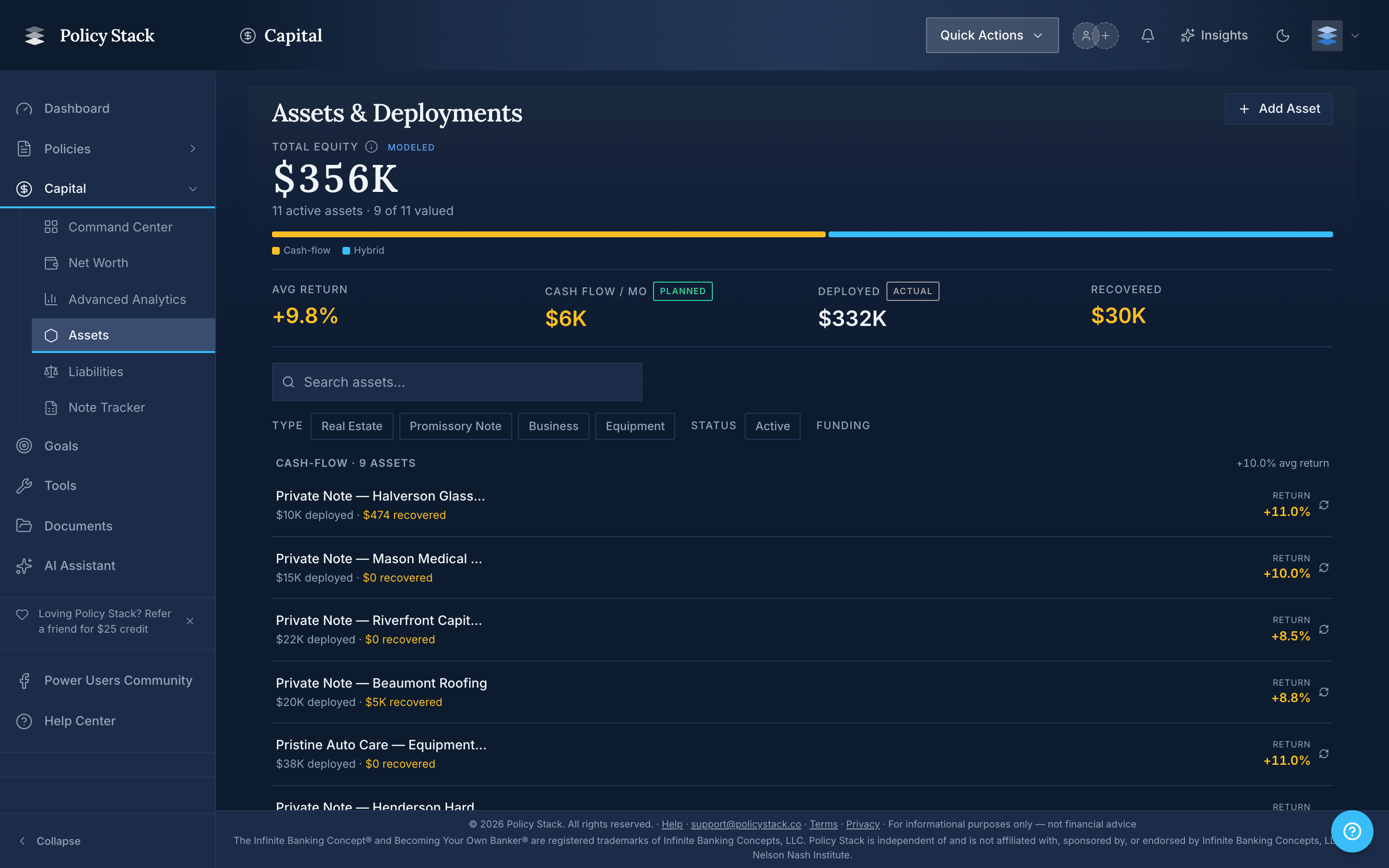
What Policy Stack Tracks
For each deployment, Policy Stack records:
- Deployment name — a description of where the capital is deployed
- Amount deployed — how much capital was directed to this opportunity
- Start date — when the deployment began
- Return rate — the expected or actual annual return of the deployment
- Linked policy loan — which policy loan funded this deployment
- Cash flows — individual capital events (inflows and outflows) over the life of the deployment
- Status — Active, Completed, or Paused
The Relationship Between Loans and Deployments
Every deployment in your banking system traces back to a policy loan. Policy Stack allows you to link deployments to their source loans, giving you a clear picture of:
- Which policy is providing the capital
- What the loan rate is (your cost of capital)
- What the deployment is returning
- The spread between the two
Deployment Status
- Active — capital is currently deployed and generating returns
- Completed — the deployment has concluded and capital has been returned
- Paused — the deployment is temporarily inactive
Why Track Deployments?
Tracking deployments gives you visibility into how your banking system's capital is working outside the policy. Combined with your policy data and loan records, deployment tracking completes the picture of your capital cycle: fund, grow, deploy, restore.
Deployment return rates and cash flows that you record are labeled as Actual data. Projections and scenarios calculated from this data carry the Modeled · Illustrative label on asset details and modeling surfaces. The Assets index is a compact summary and omits Modeled badges from its hero and asset rows; metric names and supporting descriptions still identify what each figure represents.