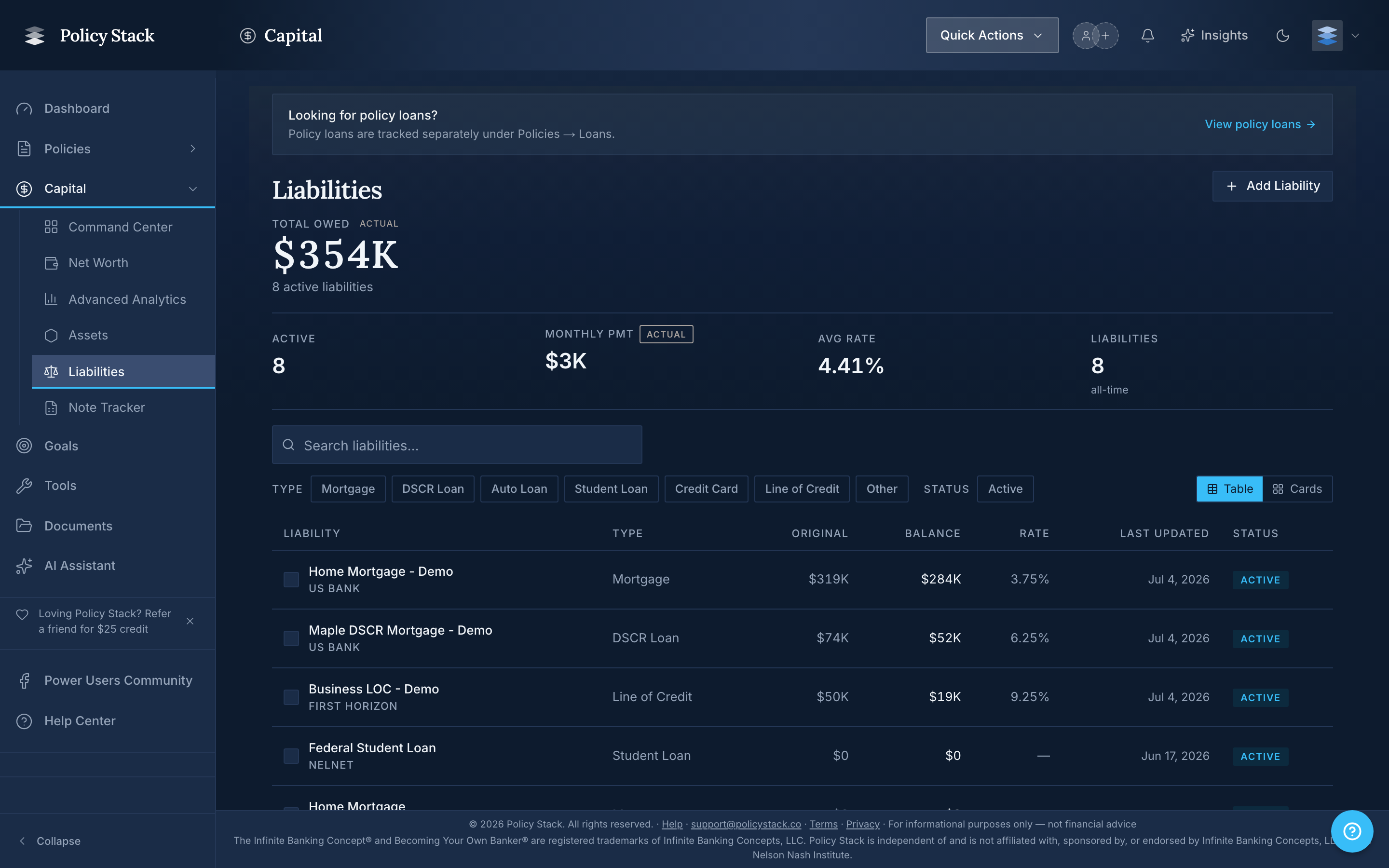
The Liabilities page records what you owe, mirroring the Assets page so your full capital picture lives in one place. It tracks installment loans (mortgages, auto, student, personal) and revolving credit (HELOCs, credit cards, lines of credit).
What Policy Stack Records
For each liability, Policy Stack tracks the name, type, current balance, interest rate, and status. Balances are stored as point-in-time records — every time you update a balance, Policy Stack keeps the prior value, so you can see how the balance has moved over time (the same way policy snapshots work).
Adding a Liability
From Capital → Liabilities, click Add liability to open a short wizard. It walks through the liability's type, the type-specific fields for that kind of loan, the current balance, the terms (rate, payment, payoff), an optional linked asset (so a mortgage attaches to the property it financed), and — for real estate — escrow and extra-principal details. You can also add a liability directly from an asset's detail page, which pre-links it to that asset. See Liabilities on a Deployment for the asset-linked path.
Updating a Balance
A liability's balance changes over time. To record a new balance, open the liability and choose Record balance. You have two paths:
- Upload a statement — drop in a PDF, PNG, or JPEG of your lender statement and Policy Stack extracts the current balance for you to review before saving. Document extraction is a Builder Pro feature.
- Enter it manually — type the current balance directly.
Either way, the new balance is stored as a point-in-time record, and the prior balance is kept so your history stays intact.
Exploring the Amortization Schedule
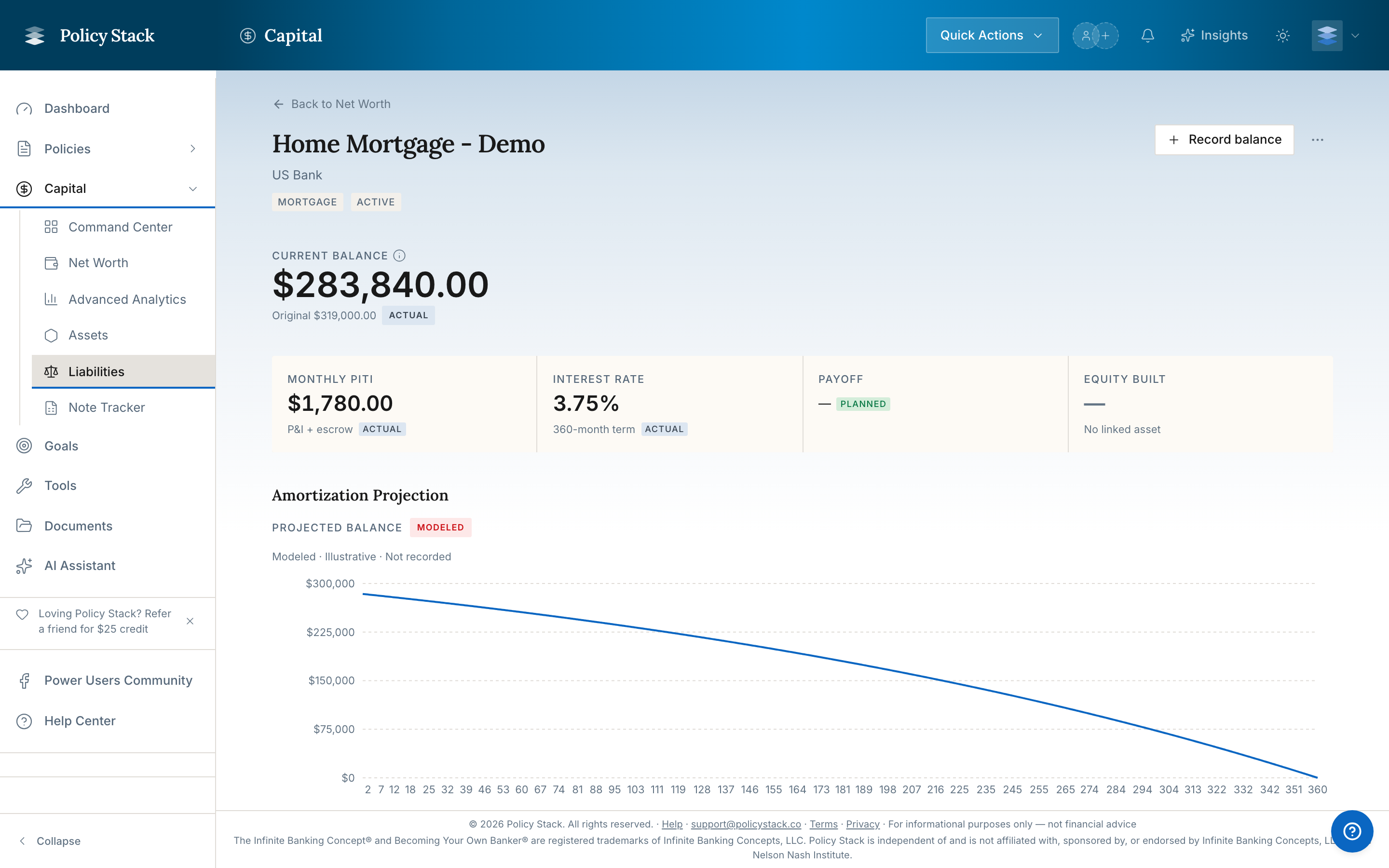
For an installment liability with a current balance, interest rate, and term, the detail page shows a month-by-month Modeled amortization schedule. Each row separates scheduled principal and interest, recurring extra principal, and the ending balance. Policy Stack uses the recorded monthly principal-and-interest amount when it can amortize the current balance over the entered term; otherwise it computes the payment from the current balance, rate, and term. Escrow is not part of the amortization calculation.
To explore a one-time extra-principal payment, click the One-time extra cell for a month and enter an amount — for example, $10,000. The selected month and every later row recalculate immediately. The summary reports the modeled change in payoff timing and interest. Choose Save schedule to keep the modeled entries on this liability for the next visit, or Clear to remove the saved entries and return to the recorded terms.
Saved inline amounts remain illustrative planning inputs. They are not added to payment history or balance history, and they do not rewrite Debt Sequencer or Payoff Path. Use Record payment separately when a payment actually occurs.
Real Estate Financing vs. Other Liabilities
- Real estate financing appears in a Financing section on the asset, capturing principal-and-interest, escrow for taxes and insurance, rate, term, and the equity you have built.
- Other balances appear as Liabilities rows you can add, edit, and remove.
Editing and Removing
Every balance entry can be edited or deleted from its row menu, and the current balance re-derives from the most recent surviving record. Policy Stack records the values you provide; it does not pull from your lender or verify them.